Disclosure: Our recommendations are based on our testing, research and analysis. We may earn a commission on products purchased using links on this page.
Table of Contents
Are you expecting? And do you have a dog? If you’ve answered “yes” to both questions, then you’re not alone!
By Guest Blogger, Elizabeth Hines
While having a dog is exciting, things can change when you plan to welcome a child into the world. The good news is, the experience doesn’t have to be stressful for both you and your dog. With preparation, you’ll be able to introduce your dog to your newborn without much issue.
In this quick guide, we’ll show you how to introduce your dog to your new baby gradually. Keep in mind: It’s important not to rush things as you make this momentous introduction.
Practice Handling
“First and foremost, you’ll need to handle your dog a certain way when you’re pregnant,” says Jerica Wilson, a pet writer at Academized. “Normally, you’ll allow your dog to lay all over you. However, when you’re pregnant, you can’t let your dog get overly excited. So, work on gentle handling techniques that get your dog to relax and be quiet. Gentle handling techniques can also be useful if your dog is sensitive about being touched in certain areas.”
New Smells, Sounds, And Objects
Next, you’ll need to introduce your dog to physical changes in the home. For example, soaps and baby powder can be something that your dog can sample with their nose just weeks leading to the special arrival.
Also, play artificial baby sounds from your phone or radio for short periods of time daily. Keep in mind: These generated sounds should be barely audible at first before increasing the volume so that your dog can get used to the noises.
Then, start placing baby things – high chairs, changing mats, playpens, and so on – into the home so that your dog can see and acknowledge them. Remember: Do this gradually so that the home doesn’t become foreign to your pet.
Preparation Two-Weeks Before Due Date
Just two weeks before your due date (provided that you’re not required to do a C-section or induction), you’ll need to prep your dog for your hospital stay. That means doing and ensuring the following:
Divide the dog food into servings.
Write down a list of helpful phone numbers for the sitter
The vet
Family members
Emergency numbers, etc.
Place your dog’s leash in a convenient place.
Prepping For When You’re In The Hospital
“When you go to the hospital, you’ll have to leave Fido at home,” adds Wilson. “That’s why you’ll need to have a family member, a trusted friend, or a dog sitter to tend to your dog’s needs as you recover at the hospital. Keep in mind: It takes time for your body to recover after giving birth to your child. So, your best bet is to have someone you trust to take care of your dog while you’re gone. Make sure that your dog has plenty of food, water, toys, and hygiene products for when you’re at the hospital.”
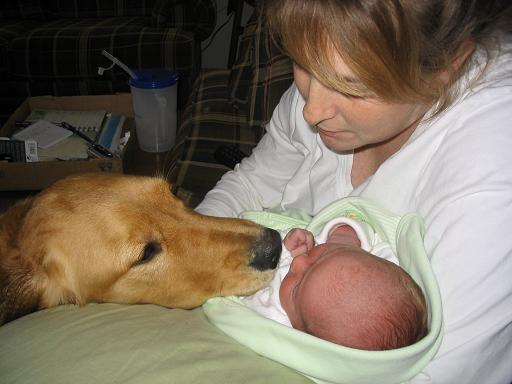
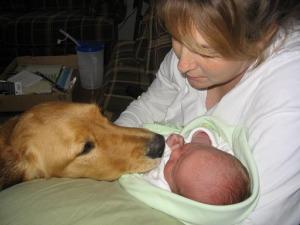
So, now that you’re back home, it’s time for the moment of truth: introducing your dog to your baby. First, have someone in your family hold your baby as you walk into the house to greet your dog. Once your dog has calmed down from its excitement, sit down with the baby, and then let your pet sniff. If the first interaction is successful, then give your pet a treat.
Supervise Dog-Baby Interactions
As your dog gets to know your baby, it’s important to supervise their interactions with each other. When supervising, keep the following objectives in mind:
Give your dog pet toys so that they’re not tempted to chew on any of your baby’s toys.
Install safety gates to keep your dog out of “baby-only” areas.
Keep your dog’s and your baby’s food separate from each other. You wouldn’t want your child to get sick from ingesting dog food or treats.
As your baby grows, they’ll grab things. Make sure that they don’t grab your dog’s tail.
Never EVER leave your child unattended with your dog. You never know if your dog will turn on your baby and either drag, knockdown, or bite them.
Conclusion
By following this quick guide, your dog’s introduction to the baby will run smoothly. Eventually, Fido and the child will become best friends forever! Ultimately, planning can help you, and your dog gets adjusted to a new baby coming into the home.
about the author
Elizabeth Hines is a writer and editor at UK Writings. As a content writer, she specializes in marketing, social media, and technologies.
Let’s talk dogs, or even better, let’s learn about dogs. Set aside some time to receive Spike’s dog blogs by Acme Canine.
With a baby on the way what preventative measures can parents-to-be take to encourage Bowser to accept the new addition to their family? The answer requires preparation and training.
If a dog has never been around babies before they may not look at a baby as a human. To insure their baby’s safety, owners need to step back and take a look at their dog’s temperament.
Has the dog ever been aggressive to strangers?
Has the dog ever been aggressive to strange children?
Has the dog ever been aggressive to smaller animals?
If the answer to any of these questions is “yes,” then one needs to be very careful with this dog around a new baby. If the answer to one of these questions is “yes,” this does not mean that this dog cannot learn to accept a baby. It simply means that the parents need to be very careful and not make any mistakes. Dog training is not rocket science. Training a dog revolves around common sense and being a responsible pet owner.
Here are 7 things to consider when a new baby is going to come into a home:
Make sure the dog is obedience trained. This means the dog should obey when you tell it to go lay down on his rug, or in his crate. And it will stay there.
Crate train the dog. If the dog becomes overly excited when the baby cries it can be put in the crate. Give it a nylabone or a rubber Kong with a little cream cheese or peanut butter in middle to keep him interested and busy. The crate should NEVER be in the bedroom.
Get a doll that makes baby noises, wrap it in a blanket and carry it around the house before the baby is born. Practice obedience commands while the doll is making noises. Once the baby is born, bring a blanket with the baby scent home to wrap the doll in.
Get the dog a selection of new dog toys before the baby comes home. Some people will keep the toys available in a basket in the living room. Others prefer to allow the dog to know that there are new toys but they control when the dog gets access to them so they don’t get bored with the toys. Another good idea is to scent the dog’s toys with a drop of flavoring such as banana or other unusual flavor.
When the baby is brought home, homecoming should not be a loud party. It is a good idea to have it be a nice quiet introduction with the dog. Mom should first meet the dog without the baby.
When the baby is brought in, the dog should be placed in a “down-stay” several feet from where mom and baby are sitting. Dogs have an excellent sense of smell. There is no reason to allow the dog to come up and smell the baby as soon as it gets home from the hospital. The dog can smell the baby from across the room without any problem.
The dog should NEVER be allowed to be near the baby when it is not being supervised – not even for a minute. If there is any concern about the obedience and control of the dog at any time the baby is present, the dog should either be on leash or in a dog crate. People ask, “When can their dog be allowed to come up and smell or lick the baby?” I cannot answer this question. Although this is usually a sign of acceptance and submission, I don’t like a dog that licks a baby. One never knows exactly what the dog has been licking just before licking the baby.
If over time your dog is still scared of your baby, i.e., gets up and moves whenever the baby gets near him. DO NOT make the dog stay next to the child. This would be courting disaster. You can not MAKE the dog feel comfortable with your child. Perhaps he will, when the child gets older. In the meantime, keep a very close eye on the dog when you’re with him and the child. Never leave them together unsupervised. For those pet owners who feel their dog cannot accept a baby or may be too dangerous around the baby, there is always a dog crate and/or an outside dog kennel.
Want to learn more about canine behavior and training? Check out our Woofie Shop
It’s packed full of over 40 years of knowledge and experience CLICK HERE
Hello again, everyone, Spike here for Acme Canine with some important information for new parents. Having your first baby causes a lot of changes in your house, and sometimes those changes can make life pretty rough on us dogs. So today I’m going to give you some tips that will help you make the transition as smooth as possible for your new baby’s furry, four-legged older sibling.
The first thing you need to understand is that we dogs think of families as packs. You, your spouse, the other dogs, and yes, even the cats, are all part of our pack, and we are driven instinctively to figure out who goes where in the pack order. You, if you’ve done dog training right, areat the head of the pack. When a new baby comes along, we tend to put them at the bottom of the pack, which makes us their boss. You’ve got to help us figure out that this noisy, smelly little bundle you’re bringing in is actually higher than we are in the pecking order. One good way to do that is to hold the baby while you give us commands – simple things like sit, come, and the like. That way we begin to associate the baby with you, and can start to understand that we aren’t the ones in charge of this new bald puppy.
Secondly, you need to help us get used to the baby before you bring him or her home. The fact is, babies are loud and they smell weird, and if you bring one into our house with no warning, we’re more likely to be upset by it. You need to start this process early. As soon as you know you’re going to be having a new baby in the house, you need to start getting us used to some of the sounds and smells we’ll have to deal with once the baby comes along.
Lots of us dogs tend to get excited and pull on our leashes or bark when we’re not supposed to or chew on toys that aren’t ours. Those sorts of issues are all best worked out before a new baby comes along, so it’s important to get any issues sorted out as soon as possible once you know the baby is on the way.
Third, you sometimes have to be a little careful with us. If we’ve never seen a baby before, we may not quite understand what it is. Our confusion can sometimes lead to some tragic misunderstandings. It isn’t that we want to hurt your baby. Some of us just haven’t had enough experience with babies to know how to behave. So you want to be sure and supervise our interactions pretty carefully, especially at first, so that you can help us learn how to behave appropriately.
Finally, make sure you don’t ignore us. Having a new baby takes up a lot of time, but most of us dogs have a hard time understanding that. All we really know is that now you’re spending all your time holding this noisy, smelly, wrinkly, ill-behaved little puppy and aren’t taking us for as many walks or going to the park or playing fetch with us as often. That can leave us confused and sad. So make a point of making time for us, too, even with the new baby in the house, so that we know we’re still important to you.
Bringing a new baby home to a house where a dog lives can be a little tricky. But following these steps can help you make the transition smooth and easy for everybody. Good luck!
Pet animals are friendly, and they can live with you at your home. It seem only fun to have a pet, but in reality it is a tough job to take care of them.